


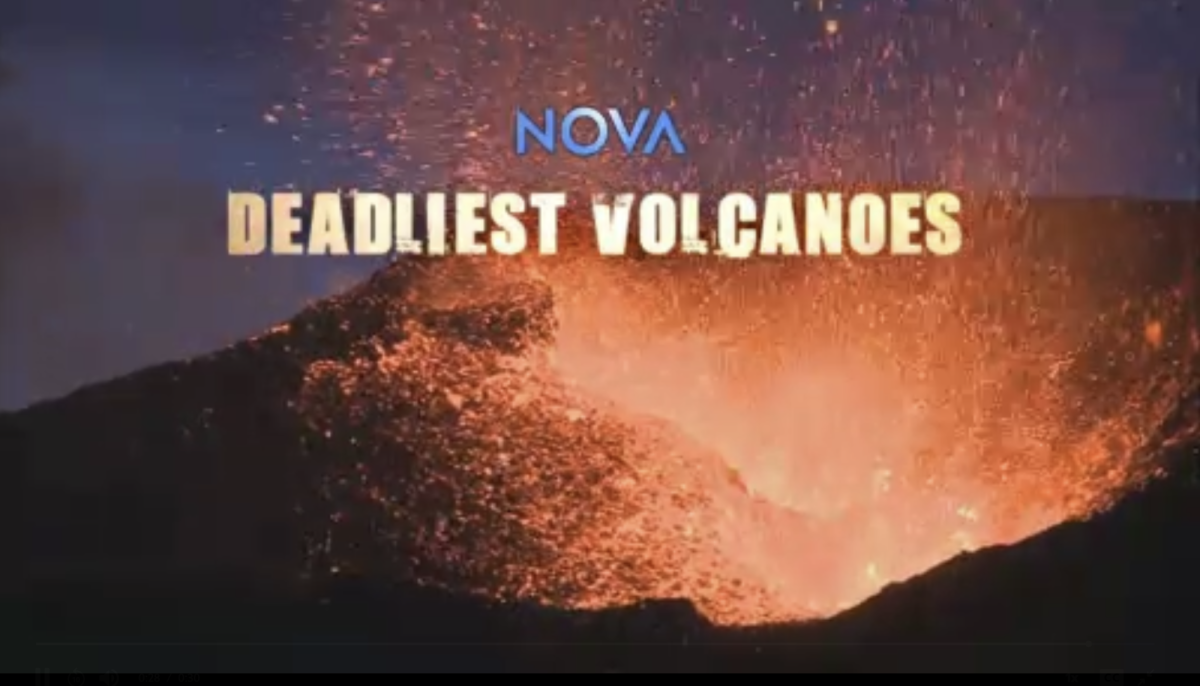


Are old documentaries still relevant? I’ve seen a few recently, and it depends. From the time I was three, I have loved the PBS NOVA documentary series. My favorite remains “Deadliest Volcanoes” from 2012. While that documentary is somewhat outdated (there have been large eruptions since then and new technology), viewers can still learn a lot about the varying systems used to monitor volcanoes and predict eruptions.
A few months ago, I watched “War from the Air” (1975). It was an interesting story of the history of aerial bombing. My favorite quote is the reference to “the current Vietnam War.” The Vietnam War has been over for almost 51 years, but at the time the documentary premiered, it was a few months from ending. The US was about to pull out of Vietnam. Interestingly, it included some excerpts from German World War II propaganda films. Since this episode was history-related, it was less outdated than the others I have seen, even newer ones.
Next, I watched “Codebreakers” (1994), which was about a machine used to figure out Japan’s encrypted communications during World War II. I did not notice any inaccuracies; however, I need to learn more about the topic.
In “Tornadoes!” (1985), which I watched most recently, the new technology is Doppler Radar, and the National Weather Service’s next big project is the NEXRAD (Next-Generation Weather Radar) system. It was interesting to see the old computers and how the storm chasers would stop at payphones to get updates from the National Weather Service radar operators once they were out of radio range. One of the professors interviewed, Dr. Howard Bluestein at the University of Oklahoma, was interviewed again in “Deadliest Tornadoes” (2012) and retired this January. In “Deadliest Tornadoes,” Dr. Bluestein drives a mobile Doppler Radar, something that
was probably inconceivable in 1985. Having seen “Deadliest Tornadoes” multiple times, I suspected Dr. Bluestein was going to be featured in “Tornadoes!”
Possibly the most outdated of all was “Space Women” (1984), in which space shuttle astronauts Sally Ride, Judith Resnik, and Kathyrn Sullivan were interviewed. These three women were the first three American women in space. During the program, the narrator notes that the orbiters (technical term for the shuttle) are built to last over 100 flight cycles and the background footage is of the orbiter Challenger. About a year and a half after the episode premiered, Challenger broke apart 73 seconds after launching on its 10th mission. Unfortunately, all seven crew members lost their lives, including Judy Resnik, the flight engineer.
In total there were 135 missions, across the five orbiters. At the end of the episode, the astronauts were asked about their expectations for the next five years. All three said they would still be at NASA and hoped to work on a space station. In reality, only Kathy Sullivan was still at NASA in 1989. She later became the NOAA Administrator. Sally Ride retired from NASA in 1987 and then became a professor at UC San Diego. She passed away in 2012. You may recognize her from one of the posters in the lower media.
Part of what interests me about old documentaries is seeing how everything has changed over time, from the trends to the knowledge at the time, to the technology. One episode from 1976 centered on the “recent success of the Transcendental Meditation movement,” something I find to be very 1970s. What will future generations say about our weird trends? Maybe “Oh, that’s so 2020s!” It is also very fun to point out the inaccuracies.
I am glad so many old documentaries are still readily available, on archive.org, Daily Motion, and YouTube. Next on my watch list are “Time Travel” (1999) and “The Mind Machines” (1978). The second centers on AI. It will be interesting to compare the predictions for AI 50 years ago with what has happened so far. Do you think they will be accurate?